


The early days of generative AI were defined by the “slottery”—a process where creators threw prompts at a black box and hoped for a usable result
It was a hobbyist’s game, rewarding patience and luck more than strategy. However, as the novelty fades, a clear divide has emerged between those playing with tools and those building systems. For creators looking to monetize their output, the focus has shifted from the individual “cool” image to the repeatable, industrial-grade production pipeline.
Sustainable creator monetization requires more than just high-quality pixels; it requires a predictable cadence and a standard of fidelity that satisfies commercial requirements. Moving from a hobbyist prompter to a creative systems operator means treating AI models as specific components in a larger factory. At the center of this transition is the ability to generate assets that don’t just look good on a smartphone screen but hold up under professional scrutiny.
The Death of the One-Off Prompt
In a commercial environment, the one-off prompt is a liability. If you are an agency lead or a solo creator building a brand, you cannot rely on a workflow that produces a masterpiece on the first try and garbage on the next ten. Clients and audiences demand consistency in style, lighting, and character integrity. When the “lottery” approach fails, it doesn’t just waste time; it erodes the profitability of the project.
Commercial readiness in the current market is defined by high-fidelity output. Most standard generative models produce images that are “fine” for social media but lack the resolution or textural detail required for print, high-definition web assets, or professional video backgrounds. This gap between “AI-generated” and “production-ready” is where many creators stall. To bridge it, operators are moving toward specialized models that prioritize structural integrity over mere aesthetic flair.


Establishing a Visual North Star with Kimg AI
The foundation of a repeatable content system is the “Visual North Star”—a set of high-fidelity base assets that dictate the tone of an entire campaign. By leveraging Nano Banana Pro AI, creators can establish this baseline with a level of precision that standard models often lack. This isn’t about just generating an image; it’s about generating a “K-level” asset that serves as the architectural blueprint for everything that follows.
In a professional workflow, the initial generation is rarely the final file. Using the specialized tuning of Nano Banana Pro, a creator can maintain stylistic consistency across multiple assets. Whether you are building a product lookbook or a set of character portraits for a narrative project, the model provides a predictable response to lighting and composition cues. Within the Kimg AI ecosystem, these assets can then be pushed through in-painting or out-painting tools to fix minor composition errors without losing the core identity of the image.
This systematic approach allows a creator to build a library of proprietary assets. Instead of starting from scratch every Monday morning, the operator uses their established “North Star” assets to branch out into new variants, ensuring that every piece of content feels like it belongs to the same universe.
From Static to Cinematic: The Image-to-Video Bridge
One of the most effective ways to monetize AI workflows is to offer “Full-Stack” content packages. A static image, no matter how high the resolution, has a lower market value than a coordinated set of cinematic clips. The modern creator pipeline uses high-quality stills as the “seed” for video generation, ensuring that the motion content matches the visual fidelity of the branding.
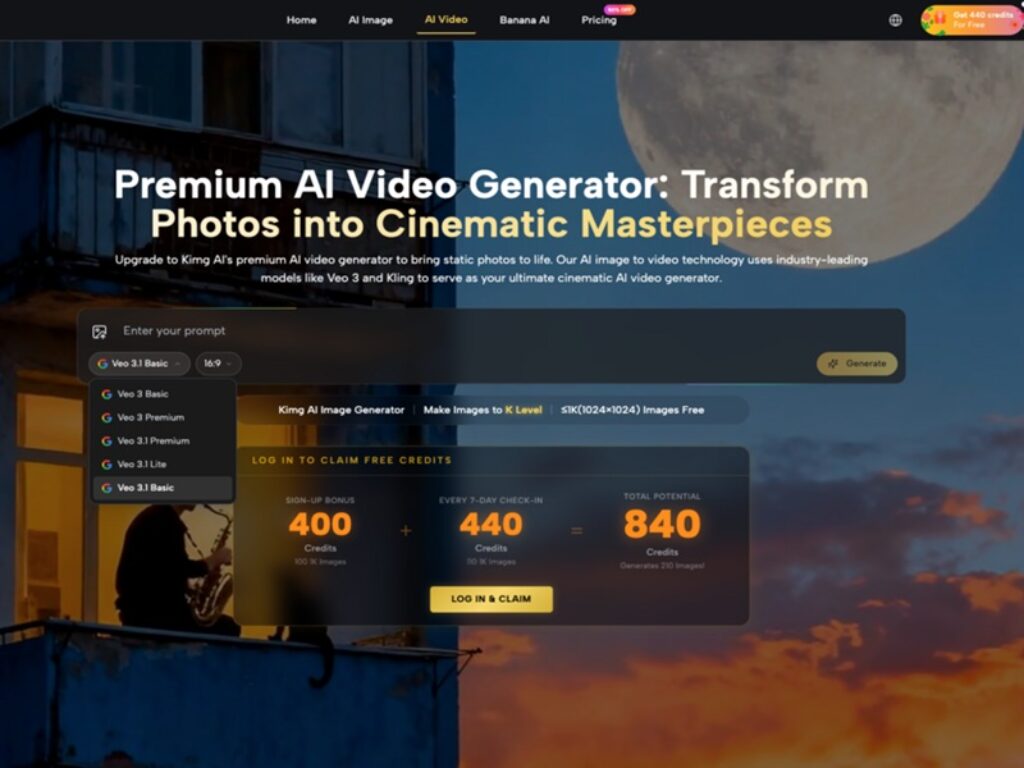
The workflow typically involves taking a high-resolution output from Nano Banana Pro and feeding it into video models like Kling or Veo 3. This image-to-video bridge is where the real value is created for brand kits. Imagine providing a client with not just 20 high-res lifestyle images, but 20 matching 5-second cinematic loops. This creates a cohesive “visual atmosphere” that brands can use across TikTok, Instagram Reels, and web headers.
However, a point of caution is necessary here: the transition from static to motion is where many pipelines face their first major hurdle. Temporal consistency—the ability of an AI to keep a face or object the same from frame 1 to frame 60—is still an evolving science. While the tools at Kimg AI provide a high-end starting point, creators must often curate several “takes” to find one where the physics of the scene don’t collapse.
Managing the Content Factory: Credits, Volume, and Value
Professionalizing creativity also means managing the economics of production. In a traditional design setting, the cost is measured in hours; in an AI-driven factory, it is measured in credit cycles and compute efficiency. To maximize a platform’s potential, creators should move away from on-demand generation and toward batch processing.
For instance, taking advantage of the weekly credit cycles—such as the 440+ credits available through consistent check-ins—requires a structured output schedule. A systematic creator might dedicate Mondays to “Style R&D,” Tuesdays to “Batch Generation” of base assets using Nano Banana Pro, and Wednesdays to “Motion Conversion.” This assembly-line approach prevents the creative fatigue that comes from trying to solve every problem simultaneously.
When you calculate the cost-per-asset, the economics become clear. A single high-resolution, commercial-grade image generated through a refined pipeline costs a fraction of a traditional stock photo or a custom photoshoot. However, this value is only realized if the quality is high enough to bypass the “AI-look” that modern consumers have learned to ignore. High-resolution upscaling is the final, non-negotiable step in this factory, ensuring the output is ready for 4K displays or large-format printing.


Where the Pipeline Breaks: Navigating Technical Constraints
No production system is perfect, and part of being a “tool-savvy” operator is knowing exactly where the tech will fail you. Even with a high-fidelity model like Nano Banana Pro, certain limitations persist that require human intervention.
First, spatial logic remains a challenge for almost all generative models. If a prompt requires three specific subjects to interact in a very precise physical way—say, a person handing a specific tool to another person—the AI may struggle with hand-to-object placement or the physics of the interaction. These complex multi-subject prompts often require multiple “fused” generations or manual editing in post-production. Relying entirely on the AI to get “perfect fingers” or “accurate text” in every instance is a recipe for missed deadlines.
Second, there is the issue of “upscaling hallucinations.” While upscaling to K-level resolution adds incredible detail, the AI sometimes “invents” textures that weren’t in the original low-res file. On a professional print job, an AI-generated skin texture might look hyper-realistic on a monitor but show repetitive patterns or “plastic” artifacts when blown up to a 40-inch poster. Human oversight at the 100% zoom level remains a mandatory step for any creator charging a professional fee for their work.
Evolving into a Creative Systems Operator
The long-term winner in the creator economy isn’t the person with the best “prompt engineering” secrets; it’s the person who builds a proprietary style library and a repeatable workflow. By hosting their assets and refining their models on platforms like those offered by Nano Banana Pro, creators are building a moat.
The role of the creator is shifting from “making” to “curating and managing.” You are no longer just the artist; you are the creative director of a digital factory. This shift requires a different mindset—one that values the robustness of the pipeline as much as the beauty of the output.
Ultimately, the democratization of these tools means that the baseline for “good” visuals has been raised for everyone. To stand out and monetize effectively, you must move beyond the experimental phase and into the execution phase. Use high-fidelity models as your engine, but let your system—your unique way of refining, upscaling, and animating those assets—be the reason clients come back. The tools are here; the challenge now is to build the factory.